
Our image consultation and personal shopping sessions with clients allow us to learn a lot. Here is what we learnt about shoes and what one should know about their foot shape. Understanding the difference between shoe size and foot shape changes everything about how you shop.
During a wardrobe session, a client laid out two pairs of shoes he wore regularly. Both were black cap-toe Oxfords. Both were well-maintained. Both were from reputable brands.
One pair showed deep creasing across the toe box, the laces pulled noticeably tight, the leather under visible lateral tension across the vamp. The other worn just as often, looked significantly more at ease. Less creasing. More even wear. The leather moving with the foot rather than against it.
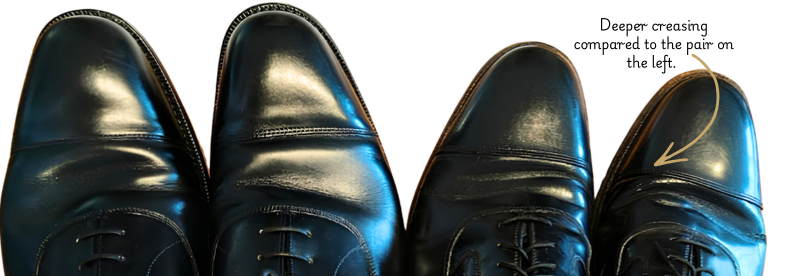
The reason why comes down to something most people never think to ask about — their foot shape and how the shoe accommodates it.
1. The Three Toe Box Shapes
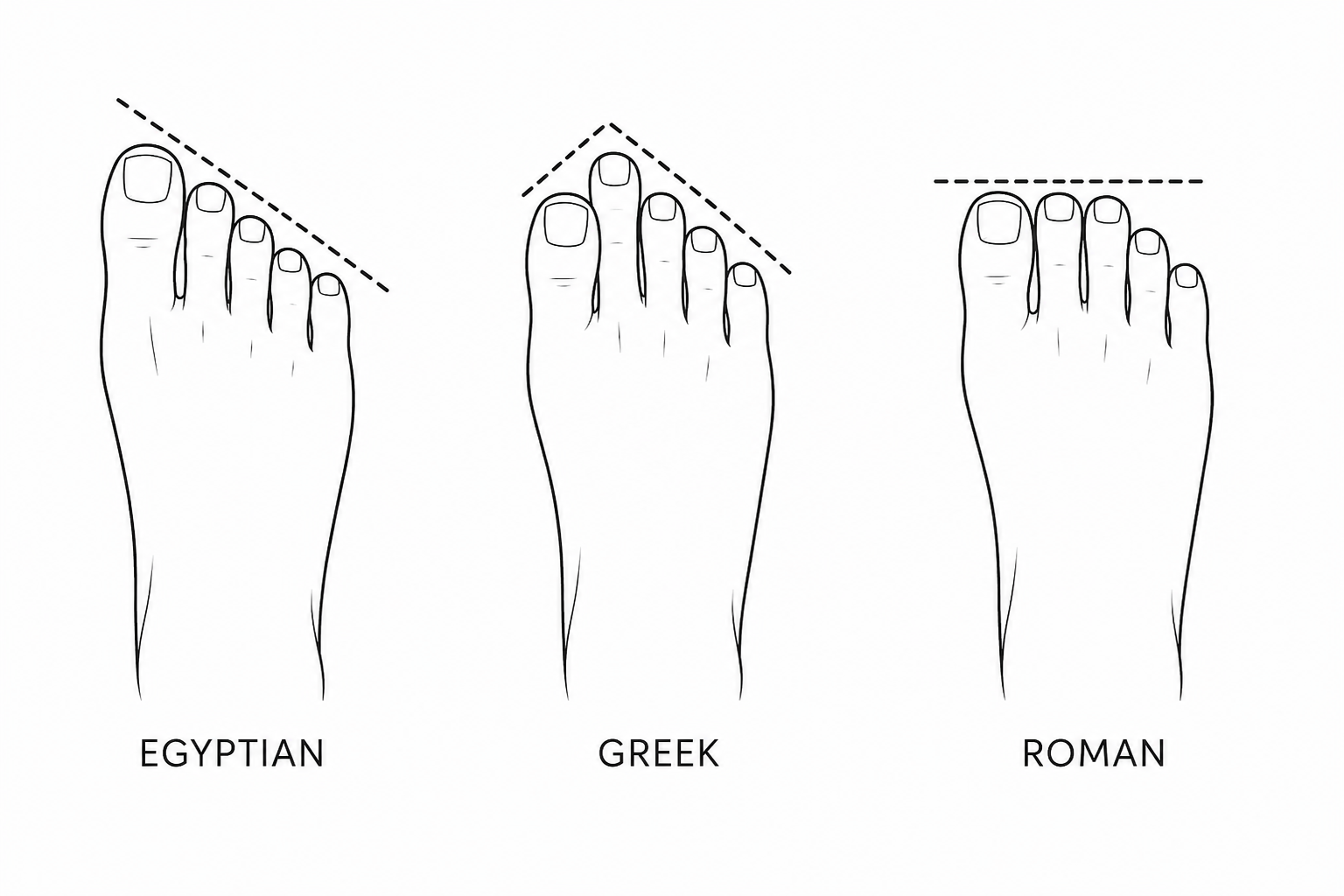
Most people know their shoe size. However, knowing your toe shape matters more than the number for finding a shoe that fits at the front. Here are the different common types.
Egyptian Foot
The big toe is the longest, with each toe graduating shorter in sequence. The most common foot type globally. Works well with a tapered or almond toe box. Pointed styles compress the big toe laterally over time — the stress crease runs diagonally from the big toe joint outward. The crease across the vamp sits deeper and more concentrated just above the big toe — the leather folding under resistance at the longest point of the foot rather than flexing evenly across the full width.
Greek Foot
The second toe is longer than the big toe. Needs more depth at the second toe position. A square or round toe box distributes pressure more evenly.
Roman Foot
The first three toes are roughly equal in length. The most forgiving foot type for most shoe shapes — but pointed styles compress all three toes simultaneously. Wide toe boxes work best and produce the most even wear pattern over time.
Why it matters practically: I think it goes without saying, as we all have experienced this – a shoe bought in the right length but wrong toe box shape will create pressure, blisters, and deformation of both the foot and the shoe — regardless of brand or price. The creasing pattern on a worn shoe often tells you which toe shape you are working with and whether the toe box was right for it.
2. Beyond the Toes: What Sizing Does Not Tell You
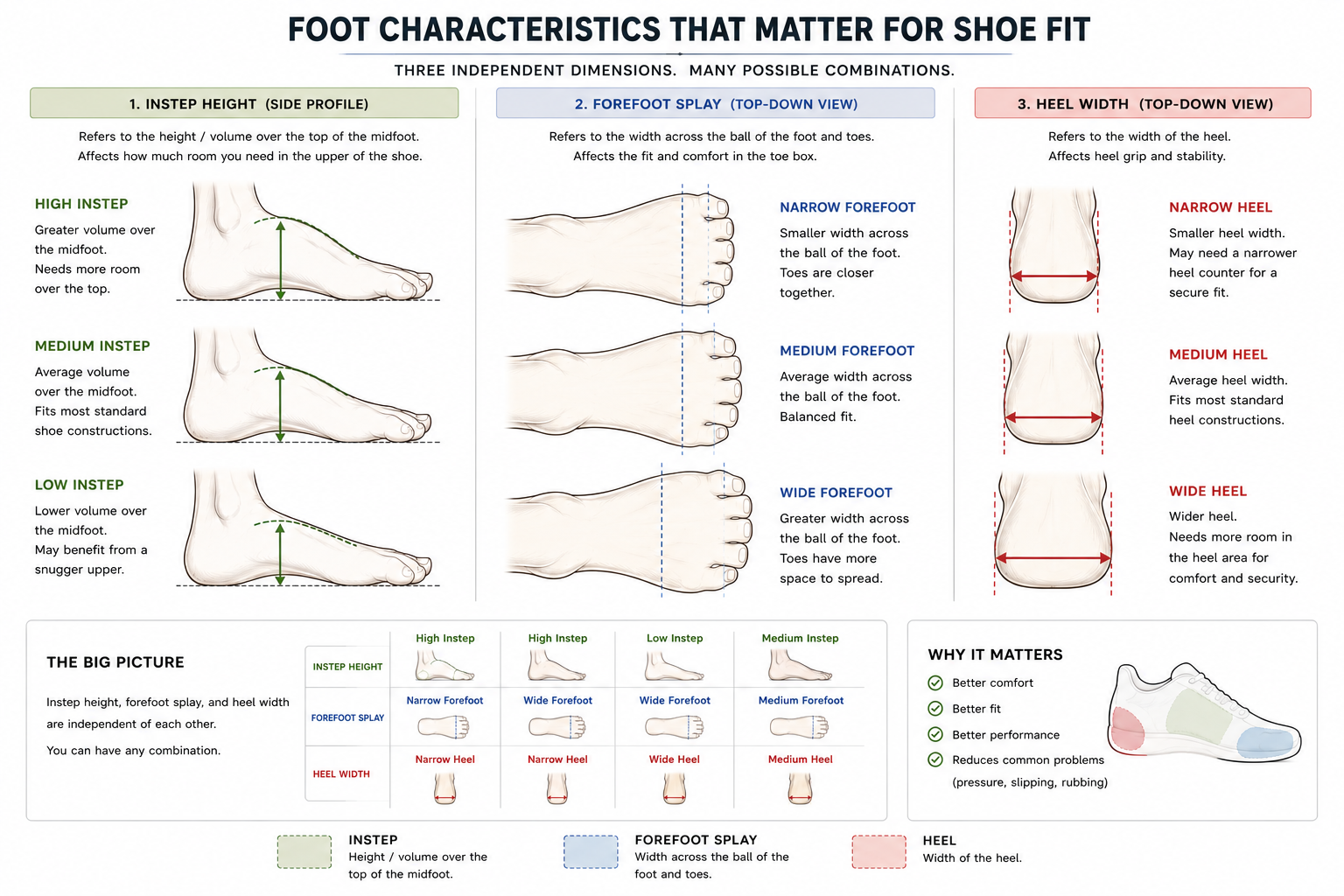
Standard shoe sizing is two-dimensional — length and sometimes width. But the foot is three-dimensional. Three measurements that sizing ignores entirely:
Foot Splay
This is how the feet spread when weight is applied. A shoe fitted while sitting may feel tight when standing and walking. The ball of the foot widens under load. A shoe that accommodates splay has enough width at the widest point of the foot, not just at the toe box. Width is often marked separately from length — a letter such as D (standard for men) or EE (extra wide) alongside the size. Most brands only stock D, so a forefoot that needs an E or EE will feel tight even in the “correct” size — this is often mistaken for a length problem when it’s actually a width one.
Instep Volume
The height of the foot — the vertical distance from the sole to the highest point across the top of the foot. A high instep has nothing to do with arch height — a flat-footed person can have a high instep, and a high-arched person can have a low one. Some individual brands publish their own instep circumference figures in size charts (measured as circumference at the widest point of the foot, tape-measure style), but that number is brand-specific and not comparable across makers — which is consistent with the point you’re already making in the blog about last numbering. Lacing style plays a role too — open lacing (as on a derby) generally accommodates a higher instep better than the closed lacing of an Oxford, though tolerance still varies by brand and last.
Heel-to-Forefoot Ratio
Some feet are wider at the forefoot than the heel. Standard lasts assume a proportional relationship between the two. A narrow heel with a wide forefoot means the shoe either slips at the back or compresses at the front — the wearer chooses one problem over the other. Neither is a satisfactory fit.
A narrow heel paired with a wide forefoot is one of the harder shapes to fit off the shelf, since most shoes assume the two proportions match. Lace-ups solve this better than slip-ons — they let you cinch the heel while leaving the forefoot room to sit properly. Softer leather helps too, moulding to the wider forefoot over time rather than resisting it. If the forefoot fits well but the heel still lifts when walking, a heel grip is a simple fix rather than a sign the shoe is wrong. When the gap between the two measurements is significant, made-to-order is often the more reliable route than searching for the right stock last.
3. Understanding Shoe Lasts: The Mould Matters
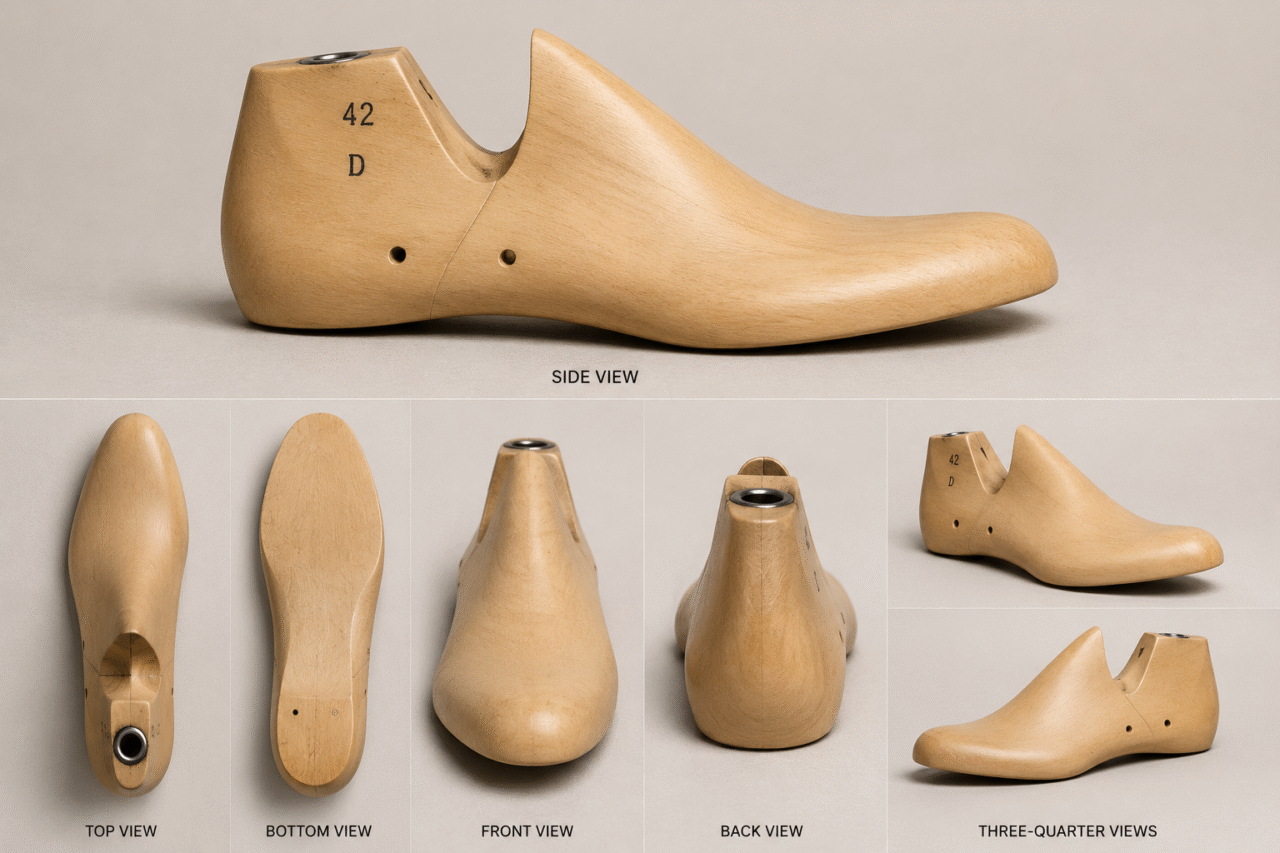
A last is the three-dimensional foot-shaped form around which a shoe is constructed. Every brand builds on its own lasts — which is why two shoes in the same size from different brands can fit completely differently. This is not a quality difference. It is a construction difference.
Two-Dimensional Sizing vs Three-Dimensional Volume
A size 43 is a length measurement. It tells you nothing about the volume of the shoe — how much space exists inside for the actual foot. A size 43 on a narrow Italian last and a size 43 on a wider English last are completely different objects internally, even if they look similar externally.
What the last determines: toe box shape and depth, instep height and volume, heel cup width, and the overall internal volume of the shoe across its length. None of this is visible from the outside. None of it appears on the size label.
What This Means Practically
Ask any shoemaker about “the last” and they’ll often reference it by a number — a code stamped somewhere on the shoe or quoted at the fitting. It sounds like something you could learn once and reuse. It isn’t.
There’s no universal system for shoe lasts. Each maker uses its own internal numbering, and a last number from one brand tells you nothing about a last from another — there’s no shared code to decipher. What actually helps is knowing your foot’s shape in plain terms: heel width, arch height, forefoot width — and asking for that shape by description, not by number. A good fitter will know their own range well enough to point you toward it.
Once you find a brand whose last suits your foot, almost everything in that brand will fit you well. This is the most useful thing to know about shoe shopping — and the thing most people discover only after years of trial and error.
To learn more about lasts and brands:
The Shoe Snob · Skoaktiebolaget ·
4. What Your Shoe Wear and Tear Is Telling You
A worn shoe is a record of how the foot moves. Before buying the next pair, it is worth reading what the current ones are saying.
Outer Heel Wear
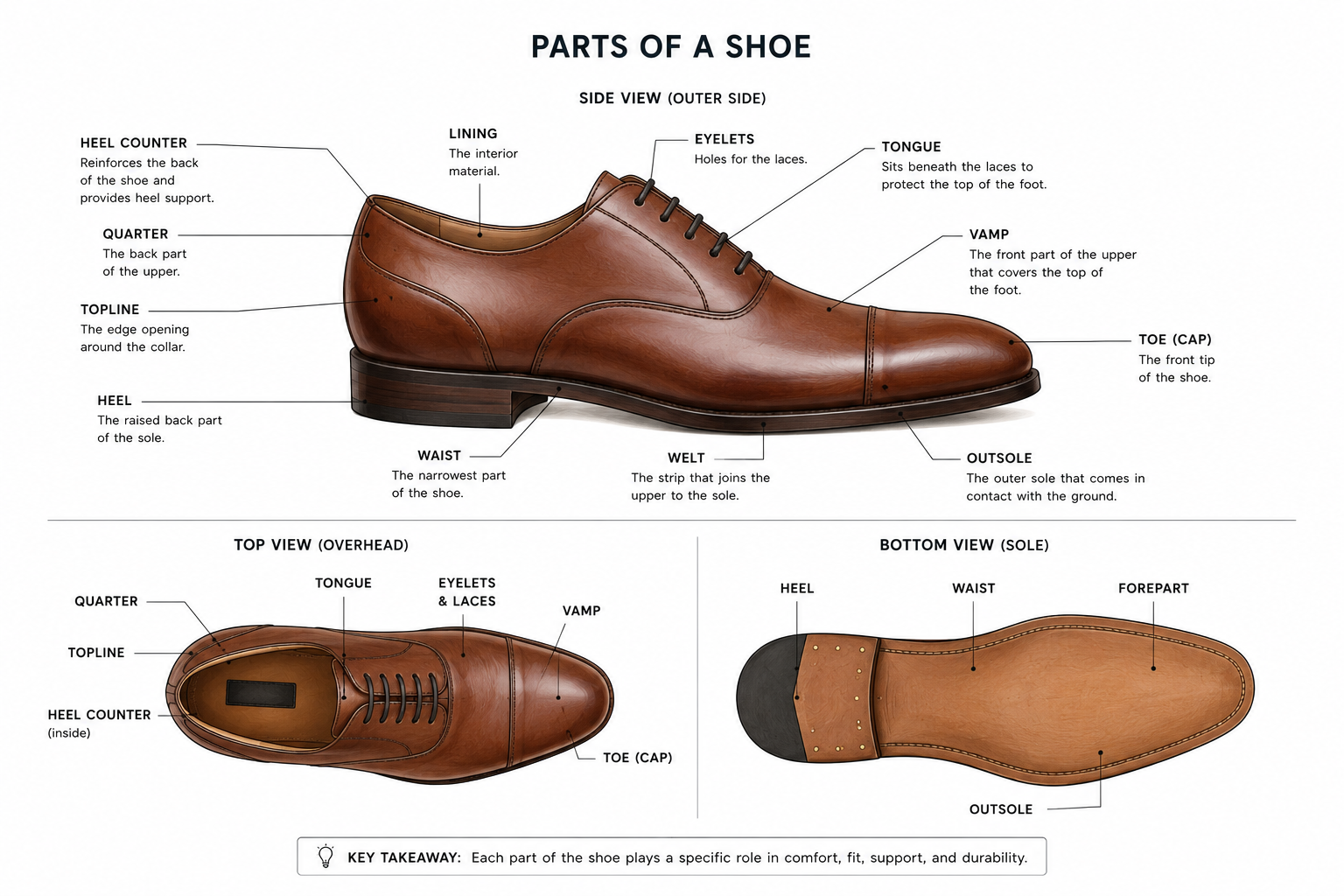
The outer edge of the heel wears significantly faster than the inner. The most common wear pattern. Indicates the foot strikes the ground on the outer edge first. Look for shoes with more structure on the outer heel and a firm heel counter in the next purchase.
Inner Heel Wear
The inner edge wears faster. Indicates the foot rolls inward during the gait cycle. A shoe with arch support and a firmer inner structure is worth prioritising. A removable insole — one that can be replaced with an orthotic — is a practical feature to look for.
Uneven Toe Box Wear Between Left and Right
If one toe box shows significantly more creasing than the other, the feet are not symmetrical — which is entirely normal but rarely acknowledged. Most people have one foot slightly larger or differently shaped than the other. The shoe should be bought for the larger or more demanding foot.
Toe Box Stress Lines
Horizontal creasing across the toe box is normal flex wear. Deep creases running down the vamp indicate the toe box is too narrow or too short. The toes are flexing against resistance rather than moving freely. The shoe is doing work it should not have to do.
Heel Counter Collapse
The stiff back section of the shoe is softened and bent inward. Either the shoe was never structured enough for the foot type, or it has been worn past its useful life. A collapsed heel counter cannot be reversed — it is a replacement signal, not a repair one.
5. What to Do at the Fitting
Bring the socks you will wear with the shoe. Try both shoes — feet are rarely identical. Shop later in the day when feet are at their largest. Stand for at least sixty seconds before deciding. Walk on a hard surface. Check the heel — it should not slip. Press the toe box — there should be a thumb’s width of space beyond the longest toe.
In Singapore specifically: factor in heat swelling, particularly if buying in an air-conditioned shop. A shoe that fits precisely in 22 degrees may feel tight in 32. One or two millimetres of extra room is not loose — it is practical.
At Image & Me, shoe fitting is part of how we approach personal shopping with clients in Singapore — understanding the foot profile before searching for suitable brands, or styles, so that what ends up in the wardrobe actually gets worn.
imageandme.com · +65 9758 3322 · info@imageandme.com
Frequently Asked Questions
Questions that come up after reading this.
How do I know my toe shape?
Stand barefoot and look down at your feet. Which toe is longest — the big toe, the second toe, or are the first three roughly equal? That tells you your toe shape. If you are unsure, a wet footprint on a flat surface shows the toe profile clearly.
What is a last and how do I find out which one a brand uses?
A last is the internal mould the shoe was built around. Most quality brands name their lasts — Church’s 173 last, for example, or Carmina’s Rain last. Skoaktiebolaget.com publishes detailed last specifications for most major brands and is the most useful free reference for this information.
Can I fix a shoe that has started to wear unevenly?
Heel wear can be corrected by a cobbler — a heel replacement is inexpensive and extends the life of the shoe significantly. Toe box creasing from a narrow fit cannot be reversed in the leather, but the information is useful for the next purchase. A collapsed heel counter cannot be repaired — it is a replacement signal.
Is it worth getting shoes resoled in Singapore?
Yes — for quality leather shoes, resoling is significantly more economical than replacement and restores the shoe to near-original condition. Several cobblers in Singapore work with Goodyear-welted shoes specifically. The upper of a well-made leather shoe can last decades with proper care — the sole is the replaceable component.
Should both feet be the same size?
Almost nobody has two identical feet. One is usually slightly longer, wider, or differently shaped. Buy for the larger or more demanding foot and adjust the other with an insole or heel grip if needed. Buying for the smaller foot creates problems on the larger one that cannot be resolved once the shoe is purchased.
Image & Me · Singapore’s Executive Image & Personal Brand Consultancy · imageandme.com