
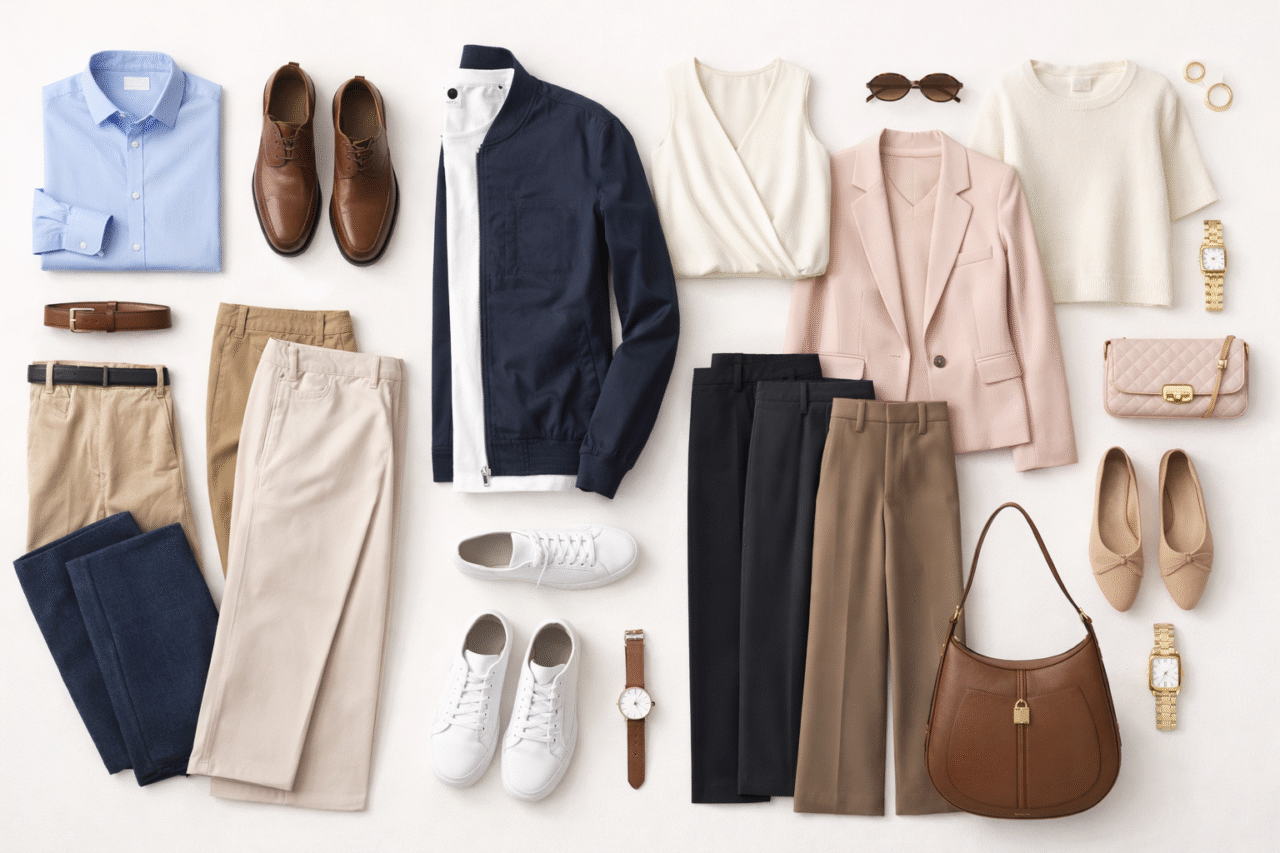
Formal dressing has a grammar. Smart casual does not. And that gap follows senior professionals into every context where the usual rules do not apply.
In Singapore alone, “smart casual” is searched over 12,100 times every month. The term has existed for a years. The question has not changed.
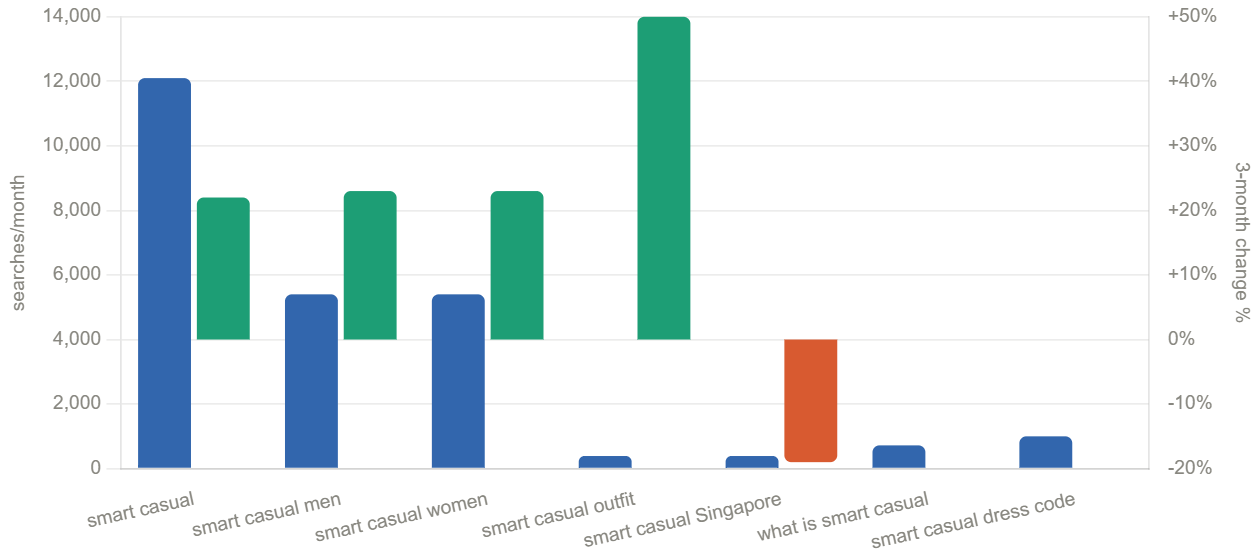
Over the years this what we have seen – every wardrobe has a formal side and a smart casual side. One of them knows what it is doing. The other owns four pairs of chinos and is figuring it out.
Think about the last time you packed for a work trip. The formal part was straightforward. Suit, shirts, shoes. A system built over years, refined by repetition, executed without much thought.
Then came the other days. The regional dinner that was business but not formal. The client breakfast that did not require a jacket but felt like it might. The off-site that said ‘smart casual’ and left the rest to your judgment.
The suitcase became more complicated.
Formal Has Rules. Smart Casual Has Judgment.
Formal dressing has a grammar most senior professionals absorbed somewhere along the way. First job, first client meeting, first time someone said ‘that jacket doesn’t work.’ The rules exist. They are learnable. Eventually they become second nature.
Smart casual has no such grammar. No one teaches it. No dress code specifies it clearly enough to be useful. And yet it shows up everywhere that matters — the leadership off-site in Bali, the industry dinner in Hong Kong, the Saturday morning event that is somehow still professional, the airport lounge where you might run into a client you haven’t met yet.
The result is not that senior professionals dress badly in these moments. It is that they dress uncertainly. The confidence completely present in a boardroom quietly disappears in front of a different set of choices.
Why Smart Casual Is Harder Than Formal
Formal dressing asks you to follow. Smart casual asks you to decide.
That decision involves more variables than it appears. The climate — Singapore in September is a different equation from Seoul in November or London in March. The context — colleagues who are also clients, a dinner where the guest list includes people you have not met. The register — relaxed enough to signal ease, considered enough to signal authority.
And unlike formal dressing, there is no external reference to check yourself against. No one in the room is in a suit to calibrate against. The framework that usually tells you whether you have got it right is simply absent.
This is where most professionals default to the safe choice. The navy polo. The familiar chino. The outfit that is unlikely to be wrong without ever being quite right.
What Smart Casual Actually Requires
Smart casual is not formal with the jacket removed. It is a different discipline with its own logic — and once that logic is clear, the decisions become as automatic as the formal ones.
The logic starts with texture and fit. Formal dressing leans on structure — the suit does the work. Smart casual replaces structure with quality of fabric and precision of fit. A well-chosen knit, a trouser with the right break, a loafer in leather rather than rubber — these are the signals that communicate effort without announcing it.
Colour plays differently too. Formal palettes are narrow by convention. Smart casual allows for more — but more requires judgment. Earthy tones that travel well. Subtle pattern that adds dimension without noise. A considered palette that is clearly personal rather than accidental.
And then there is the question of the one piece that lifts everything else. In formal dressing it is often the tie or the pocket square. In smart casual it is usually the jacket — unstructured, worn over almost anything — or a single accessory that carries enough weight to make the rest of the outfit deliberate.
The Off-Duty Image Is Still Part of the Brand
There was a time when the professional image was defined almost entirely by what happened in formal settings. That time has passed.
Leadership is now visible across far more contexts than a decade ago. Industry events that are social in format but professional in consequence. Regional travel where you represent your organisation in every room you walk into. LinkedIn — where how you look in a photograph taken at a business dinner communicates as much as anything you post.
The professionals whose image holds across all of these contexts have not dressed more carefully. They have thought more clearly — once — about what they want to communicate, and built an approach that travels with them. The context changes. The standard does not.
Building the Smart Casual Framework
In our work with senior professionals and C-suite executives in Singapore, smart casual is consistently the area where the most time is spent — not because clients lack taste, but because it is the one context where no one has ever given them a clear framework.
The framework is not complicated once it exists. A palette that works across climate and context. A small number of pieces with enough versatility to combine in multiple ways. An understanding of which occasions call for which register — and why.
Once it is in place, packing for a work trip takes fifteen minutes. The off-site is not a problem to solve the night before. The image that was confident in the boardroom stays confident at dinner.
That is not a style upgrade. It is a professional image consultant in Singapore doing what the work is actually for — removing the decisions so the thinking can go somewhere more useful.
Image & Me works with senior executives and C-suite professionals in Singapore on wardrobe strategy, personal shopping, and complete style makeovers — including smart casual frameworks built for the way they actually work and travel.
imageandme.com · +65 9758 3322 · info@imageandme.com
Frequently Asked Questions
Questions that come up after reading this.
Is smart casual actually different for different industries?
Yes, and significantly. A smart casual register for a banking executive in Singapore reads differently from a tech CEO at a product launch or a consultant at a client offsite. The underlying principles are the same — fit, fabric, considered palette — but the calibration shifts. This is exactly why a generic framework does not work and a personal one does.
What are the most common mistakes senior professionals make with smart casual?
The most common is dressing down too far — removing the formality without replacing it with anything considered. The second is treating smart casual as an occasion to wear whatever did not make it into the formal rotation. Neither works. Smart casual requires its own investment of thought, not the leftover capacity from the formal wardrobe.
Does this apply equally to men and women?
Yes — and with different challenges for each. Men tend to have a narrower range of options and default to safe combinations that are neither wrong nor right. Women often have more range but fewer reference points for what reads as authoritative rather than casual in a professional setting. The work is different but the need is the same: a framework that travels.
How many pieces do you actually need to cover smart casual properly?
Fewer than most people expect. A well-built smart casual capsule for a senior professional typically involves eight to twelve pieces that combine across multiple contexts. The number matters less than the logic connecting them — a consistent palette, a range of formality within the same register, and pieces that earn their place in more than one situation.
Can a wardrobe stylist or image consultant actually help with smart casual specifically?
This is one of the most common reasons senior professionals come to Image & Me. It is the everything that needs strategic attention: the travel capsule, the off-site, the client dinner, the regional trip. A personal shopper in Singapore who understands the professional contexts of their clients can build this framework efficiently and permanently.