
For senior executives in Singapore, executive image extends well beyond the boardroom. When a senior professional steps onto a stage or in front of a camera at a high-profile event, the visual rules change. Here is what the medium actually requires — and why it belongs on the preparation list.
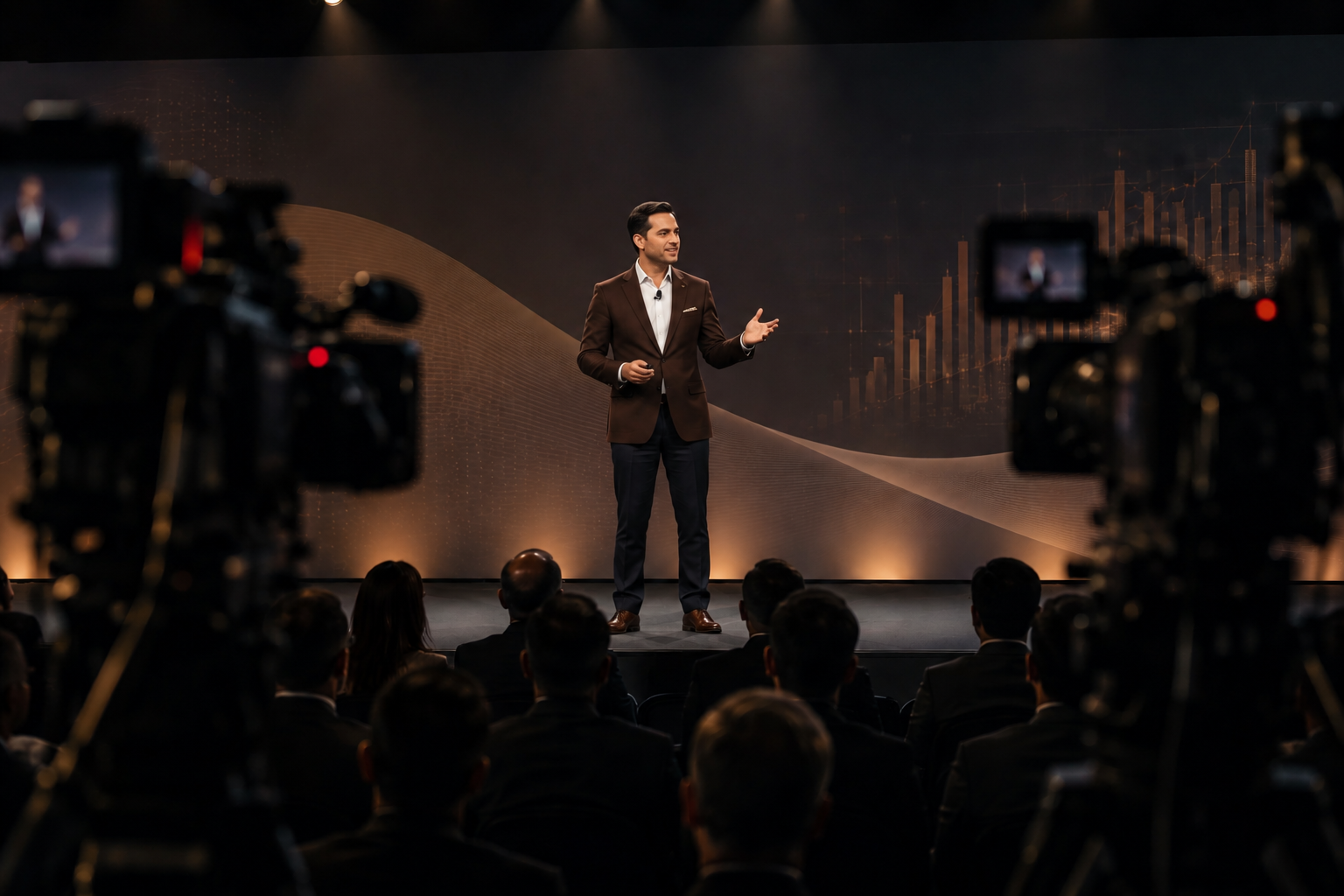
The preparation for a high-profile speaking moment is thorough by nature.
Content worked and reworked. Talking points sharp. Bio updated. Everything that can be controlled has been considered — because the moment matters and the audience is significant.
What gets addressed last, or not quite completely, is what to wear.
Most senior professionals think about it. They reach into a wardrobe that has served them well and choose something appropriate — or buy something for the occasion. The intention is right. What is sometimes missing is an understanding of what the stage and the camera actually require — which is different from what the office or the boardroom requires, in ways that are not always obvious until you see the photograph the next day.
The Medium Changes the Equation
A stage is not a meeting room. A camera is not a colleague across a table.
Under stage lighting, colours behave differently from how they appear in natural light or a mirror at home. White bleaches out under strong lighting and flattens the face. Pure black absorbs light and can merge with dark backgrounds, removing definition. The colours that read most clearly on camera and under stage lighting — mid-navy, warm mid-tones, deep jewel colours, structured neutrals — are not always the most obvious wardrobe choice.
Busy patterns create a specific problem on camera. Fine stripes, tight checks, and small herringbone weaves produce a visual vibration on screen — a phenomenon known as moiré — that becomes distracting regardless of how well the outfit works in person. The pattern becomes the thing the audience is looking at rather than the person wearing it.
Fit reads differently under a spotlight and through a lens. A jacket that sits well standing can bunch at the lapel when a microphone is clipped to it. Fabric that feels considered in a dressing room can look shapeless when the camera crops the image from the waist up.
What the Photograph Reveals
High-profile events are documented from every angle. The keynote recording. The panel photograph. The group image taken during a break. The candid shot that ends up on the event’s social media before the session has finished.
Each context reveals something different from what standing in a mirror shows. The seated front-row photograph is one of the most revealing — and least prepared for. Skirt length that works at a desk becomes a source of discomfort and distraction when seated on a low stage chair. Sock length that is invisible standing becomes visible in every seated image. How a collar sits when a lapel microphone is attached. How a jacket falls at the shoulder when arms are resting on a panel desk.
None of these are details a professional wardrobe overlooks in the office. They are details that the specific context of a high-profile event makes newly consequential.
Reading the Room Before You Enter It
Not every high-profile event calls for the same image decision.
A closed-door leadership forum — intimate, senior, invitation-only — operates by different visual logic from a large-scale industry conference with a mixed audience of founders, investors, regulators, and early-career professionals. A financial services summit reads differently from a technology event. A regional Asian conference has different cultural reference points from a global one.
The questions worth asking before any significant speaking moment are the same ones that inform every other aspect of the preparation. Who is in the room — and what do they expect to see? What does the event signal about its register? What do you want to communicate, and does the image reinforce that or create friction with it?
A speaker at a FinTech conference who is the most formally dressed person on stage is making a choice — whether they intended to or not. So is the one who is the least. The image is always communicating something. The only variable is whether that something was decided deliberately.
The Standards Exist – IYKYK
There is a level of professional visibility where image choices are read as signals about authority, credibility, and attention to detail. The professionals who regularly operate at this level understand this — not always through formal instruction, but through the accumulated experience of being in enough of these rooms to know what works and what does not.
The standard is not about dressing formally or expensively. It is about dressing deliberately for the medium and the audience. Choosing colours that hold under stage lighting. Avoiding patterns the camera cannot process. Ensuring fit that works not just standing but seated, moving, and photographed from every angle. Selecting accessories that complement rather than compete — or create noise on a lapel microphone.
Communications teams cover some of this in speaker briefs — typically colours and patterns for broadcast. What they rarely cover is the full picture: what the body does on a stage chair, how a silhouette reads under a spotlight, what the group photograph reveals about a choice that felt right in a mirror at home.
What You Want Your Image to Communicate
The most effective on-stage image does not draw attention to itself. It removes the need for the audience to think about anything except what the speaker is saying.
When the image is considered — colour, fit, formality, detail — it becomes invisible in the best possible way. It aligns with the authority of the content rather than distracting from it. The room is not thinking about the outfit. It is thinking about the person and the ideas.
That alignment — between what you are communicating from the stage and what your image is communicating before you have said a word — belongs on the preparation list. Not as an afterthought. As part of the same rigour applied to everything else that matters about the moment.
How We Approach This at Image & Me
Preparing clients for high-visibility moments — keynotes, panels, media appearances, conference photography — is a distinct part of the work we do through the SIGNAL Framework™.
The Narrative pillar of the framework addresses precisely this: the deliberate visual story your presence tells before you speak. On a stage, that story is being told to a live audience, a camera, a photographer, and anyone who sees the event coverage afterwards — simultaneously. Building an image that holds coherently across all of these requires thinking through the context specifically, not just the wardrobe generally.
Image & Me works with C-suite executives and senior professionals in Singapore on executive image strategy — including preparation for high-visibility speaking moments, keynotes, and media appearances.
Frequently Asked Questions
Questions that come up after reading this.
What colours work best on stage and on camera?
Mid-tones read most consistently under stage lighting and on camera — navy, mid-blue, warm grey, burgundy, forest green, and deep jewel tones. White and pure black can be problematic — white bleaches under strong lighting, black loses definition against dark backgrounds.
Why do patterns cause problems on camera?
Fine stripes, tight checks, and small herringbone patterns create a moiré effect — a visual vibration that the camera cannot process cleanly. The pattern becomes distracting regardless of how the outfit looks in person. Solid fabrics or very subtle textures read most cleanly on camera. Heavy textures creates a bulky silhouette. A clean silhouette creates a structured, sharp look.
How does dressing for a panel differ from dressing for a keynote?
A keynote speaker is upright and moving — the full silhouette is visible and the image needs to work in motion. A panel speaker is primarily seated — which makes skirt length, sock length, jacket fit at the shoulder, and collar behaviour under a microphone all more consequential.
Should I dress differently for a FinTech event versus a financial services conference?
Yes — the audience, the register of the event, and what you want to signal all inform the decision. A financial services forum typically calls for a higher formality register than a technology or startup conference. The question is not which dress code to follow but what your image communicates in the specific context of that room and that audience.
What should I consider about accessories for a speaking engagement?
Two practical considerations: sound and visual distraction. Dangling earrings and metal necklaces can create noise on a lapel microphone. Visually, accessories that catch light strongly can draw the eye away from the face — which is where the audience’s attention should be throughout.